Reducing the Cost of Quality
Stop fighting fires at the end of the line. Learn why the "inspect and reject" model fails and how to implement a "monitor and correct" strategy to cut costs and prevent defects.
You Can't Inspect Your Way to Excellence
You know the feeling. A customer calls on a Friday afternoon. A defective part has slipped through. Your stomach drops.
Within the hour you're in a room with the production manager and quality lead, staring at drawings and trying to work out how it happened. And then, because you need to do something — and be seen to do something — you reach for the oldest tool in the box.
You add another inspection step.
It feels like action. It isn't. All you've done is hired a goalkeeper after the defence has already collapsed.
The trap most factories are stuck in
The "inspect and reject" model has a fundamental flaw: by the time a part reaches final inspection, you've already spent everything on it. Material, machine time, operator hours. If it fails now, you've burned cash, not just a component.
Worse, 100% inspection is never truly 100%. Ask a person to check 5,000 identical parts for a minor defect and they will miss some. We get tired. We get bored. Bad parts still escape.
There's a cultural cost too. Heavy reliance on final inspection creates a factory floor where operators feel no ownership of quality - "QC will catch it" - and inspectors become the enemy. It breeds blame rather than improvement.
Monitoring instead of inspecting
Defects don't appear from nowhere. They're the result of a process drifting — a tool wearing down, a temperature fluctuating, a new material batch behaving slightly differently. If you're only checking the finished part, you won't see that drift until it's already a reject.
Monitor the process instead and you see the trend while you can still do something about it. The dimension is creeping towards the limit but still good — the operator makes a small adjustment and carries on. No scrap made. No manager called.
Think of it like driving. You don't wait to hit the barrier before correcting your steering. You watch the road and make small adjustments constantly. Inspect and reject is driving with your eyes closed. Monitor and correct is keeping them open.
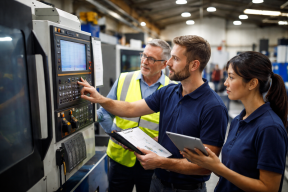
Getting there in practice isn't complicated. Move your critical checks from the end of the line to the machine itself. Give operators control limits, not just pass/fail tolerances. Tell them exactly what to do when something drifts. Make them the pilot, not the sorter.
Where FactoryIQ fits in
Paper-based systems are where good intentions go to die. Clipboards get oily, binders go out of date, and control charts nobody updates are worse than useless.
FactoryIQ puts digital work instructions, in-process checks, and real-time SPC monitoring directly at the machine. Operators get alerts when a trend is developing — before it becomes scrap. Managers get live visibility without chasing people for updates. And when an auditor walks in, the full process history is already there.
It doesn't replace good process discipline. It makes it stick.
Boring is profitable
When this works, the shop floor gets quieter. Not less busy - just less panicked. Your quality team stops sorting parts and starts coaching people. Your morning meetings stop being post-mortems.
That's what good looks like. If you'd like to see how FactoryIQ supports that shift, we're happy to show you around the platform - no hard sell, just a practical look at how it works.